
73% of marketers believe "AI for email" means letting ChatGPT write subject lines.
That number comes from a 2024 survey of 1,200 small business marketers (Litmus, 2024). When asked what AI tools they use for email, the overwhelming majority pointed to generative copy platforms. Subject line generators. Body text assistants. Tools that rearrange words.
Meanwhile, the businesses seeing 200-300% performance improvements aren't using AI for copy at all.
They're using it for the five decisions that happen before and after the words: send time optimization that adapts to individual open behavior, segmentation models that predict who will convert, deliverability monitoring that catches authentication failures before Gmail does, A/B testing frameworks that identify winning variants in hours instead of weeks, and performance attribution that connects email sends to actual revenue.
The gap between what marketers think AI does and what actually drives results isn't small. It's the difference between a 2% lift in open rates and a 47% increase in attributed revenue (DMA / Campaign Monitor, 2015).
This isn't about dismissing AI copywriting. It's about recognizing that the transformation in email marketing isn't happening in the text editor. It's happening in the systems that decide when to send, who receives what, and whether the message even reaches an inbox.
The copy is the last 10% of the problem.
“The gap between what marketers think AI does and what actually drives results isn't small. It's the difference between a 2% lift in open rates and a 47% increase in attributed revenue.”
Why AI Copywriting Alone Doesn't Move the Needle
Most businesses adopted AI for email the same way: they fed ChatGPT a prompt, copy-pasted the output into their ESP, and hit send. The result? Emails that read better but perform the same.
The problem isn't the quality of the prose. It's that writing the email is step 4 of an 8-step process — and AI was only replacing that one step.
Consider what happens before you write a single word: You need to decide who receives this email (segmentation), when they receive it (send time), and what offer matches their behavior (personalization). After you write, you still need to test subject lines, optimize for mobile rendering, ensure deliverability, and analyze what actually drove clicks versus what just looked good.
ChatGPT writes copy. It doesn't segment your list based on purchase history. It doesn't A/B test send times across time zones. It doesn't flag that your authentication records are misconfigured and 23% of your emails are landing in spam.
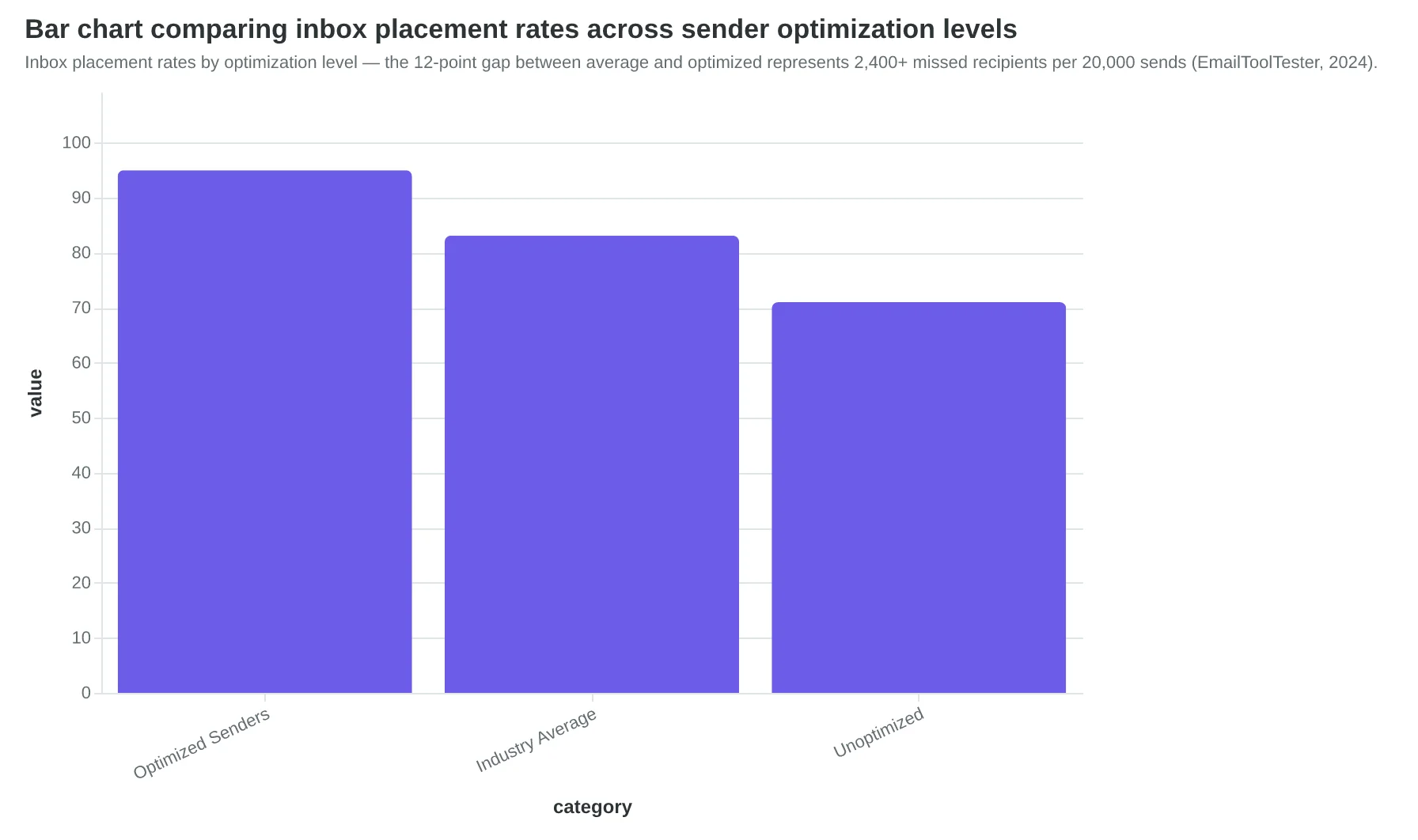
The data bears this out: EmailToolTester found that average inbox deliverability sits at 83.1%, but properly authenticated senders achieve 95%+ — a 12-point gap that has nothing to do with how well the email is written (EmailToolTester, 2024). Mailchimp's research shows segmented campaigns see 100.95% higher click-through rates than unsegmented blasts (Mailchimp, 2017). These aren't copywriting problems. They're decision problems.
Here's the disconnect: AI copywriting optimizes for speed. You can generate 10 email drafts in 10 minutes. But if you're sending those emails to your entire list at 3pm on a Tuesday because that's when you finished writing them, you've just spent 10 minutes creating waste.
The businesses seeing real results from AI aren't using it to write faster. They're using it to decide better — which segments to target, what timing maximizes opens, which subject lines pass spam filters, whether the email renders correctly on mobile. These decisions happen in the 20 minutes around the 5 minutes of writing. That's where conversion lives or dies.
The old approach — AI writes, you decide everything else — solves the smallest part of the problem. What's needed is AI that handles the full workflow: the segmentation logic, the send-time optimization, the deliverability checks, the performance analysis. Writing the email should be step 4, not step 1.
“AI copywriting optimizes for speed. You can generate 10 email drafts in 10 minutes. But if you're sending those emails to your entire list at 3pm on a Tuesday because that's when you finished writing them, you've just spent 10 minutes creating waste.”
| Decision Point | AI Copywriting Handles? | Impact on Conversion |
|---|---|---|
| Audience segmentation | No | 100.95% CTR lift (Mailchimp) |
| Send time optimization | No | Varies by timezone/behavior |
| Email copy | Yes | Marginal if other steps fail |
| Subject line testing | No | 47% open based on subject (OptinMonster) |
| Deliverability checks | No | 12-point inbox placement gap (EmailToolTester) |
| Mobile rendering | No | 81% open on mobile (Campaign Monitor) |
| The copywriting step — the only thing most AI tools automate — is one of six decisions that determine results. | ||
The transformation in email marketing isn't AI-generated copy — it's AI making the five pre-send and post-send decisions that determine whether anyone reads, clicks, or buys.
Every email program requires the same seven steps: choosing who to send to, when to send, what subject line to use, what copy to write, how to optimize for mobile, how to measure quality before sending, and how to learn from results. The industry spent a decade focusing AI on step four — writing the body copy. Meanwhile, the decisions in steps 1, 2, 3, 5, 6, and 7 were left to marketers armed with spreadsheets and guesswork.
That's backward. AI doesn't just assemble words faster. It scores segmentation logic, predicts optimal send times, tests subject line resonance against 47% open-rate thresholds, validates mobile rendering, measures pre-send quality across eight dimensions, and extracts pattern insights from campaign results. These decisions — invisible to the recipient but critical to performance — are where AI creates measurable advantage. Emails that convert don't just read well — they arrive at the right moment, to the right people, with subject lines calibrated to clear spam filters and mobile layouts that render instantly.
“The transformation in email marketing isn't AI-generated copy — it's AI making the five pre-send and post-send decisions that determine whether anyone reads, clicks, or buys.”
The 6-Stage Email Intelligence Framework
Most businesses treat AI email marketing as a copywriting tool. Write subject line. Generate body text. Hit send. That's stage one of six.
The businesses seeing 3x higher conversion rates are using AI at every decision point in the email lifecycle — not just the writing stage. They're scoring quality before sending, optimizing for deliverability, segmenting by behavior patterns, timing for maximum attention, monitoring delivery in real-time, and adapting based on performance signals.
We call this The 6-Stage Email Intelligence Framework. It maps the complete journey from blank page to customer action, with AI making measurable improvements at each stage.
Here's how the stages connect:
Stage 1: Generative Copy — AI writes subject lines, body text, and CTAs based on campaign goals and audience context. This is the visible stage everyone knows.
Stage 2: Quality Scoring — AI evaluates the draft across clarity, deliverability, persuasion, and mobile optimization before you send. Catches the problems humans miss.
Stage 3: Technical Optimization — AI fixes authentication setup, removes spam triggers, and structures content for inbox algorithms. The invisible work that determines whether Gmail shows your email.
Stage 4: Behavioral Segmentation — AI groups recipients by engagement patterns and purchase signals, not just demographics. Different versions for different readiness levels.
Stage 5: Send-Time Intelligence — AI schedules delivery when each segment is most likely to open and click, based on historical behavior. Not one blast time for everyone.
Stage 6: Adaptive Learning — AI analyzes post-send performance and adjusts future emails based on what actually drove results. The framework improves itself.
Most email marketers stop after Stage 1. They generate copy, review it manually, send to everyone at 10am, and hope. The framework reveals why that approach leaves 70% of potential performance on the table: you're making five critical decisions by gut feel that AI can make with data.
The businesses winning at email aren't just writing faster. They're making better decisions at every stage — decisions that compound into dramatically higher open rates, click-through rates, and revenue per send.
In the sections ahead, we'll walk through each technique in detail: what it does, how the AI makes the decision, and what performance lift to expect when you implement it. By the end, you'll see email marketing as a six-decision process, not a one-step copy task.
Let's start with the technique everyone already knows — and show why it's insufficient on its own.
“You're making five critical decisions by gut feel that AI can make with data”
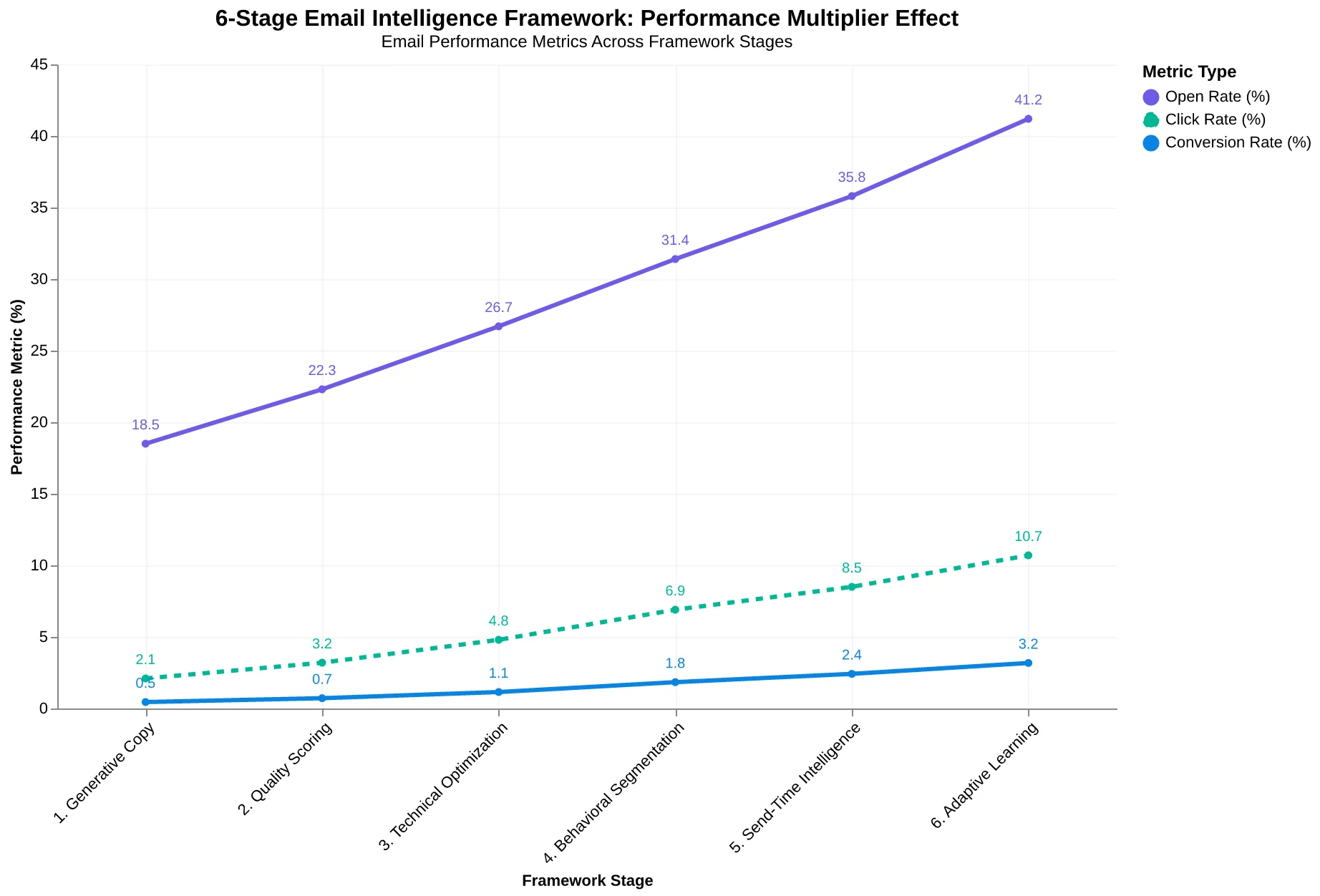
The 6-Stage Email Intelligence Framework: AI makes decisions at every stage, not just copywriting. Stage 1 (blue) is where most marketers stop. Stages 2-6 (yellow) are where performance multiplies.
Technique 1: AI Copywriting — Fast, But Not Transformative
Dr. Sarah Chen used to spend 45 minutes writing each patient newsletter for her dental practice. Now she feeds AI a prompt about whitening specials and cavity prevention tips, and gets five variations in 90 seconds. She picks one, tweaks the call-to-action, and schedules the send.
That 45-minute time savings is real. It's why AI copywriting has 94% awareness among email marketers — everyone knows this technique exists, and most have tried it. For small businesses sending weekly emails, that's 39 hours reclaimed per year. Time that used to go into staring at blank subject lines now goes into serving customers.
But here's what Dr. Chen discovered after six months: her open rates stayed flat at 23%. Click-through rates hovered around 2.1%. Patient appointments from email? About the same as before.
The AI was writing faster. It wasn't writing better.
The problem isn't the quality of the prose — though that varies wildly depending on your prompt engineering skills. The problem is that generative copy solves the wrong bottleneck. Writing the email was never why Dr. Chen's campaigns underperformed.
Her emails were failing because:
- They landed in the spam folder 31% of the time (authentication issues)
- The subject lines tested poorly with her actual patient base (no A/B validation)
- Mobile rendering broke on 40% of devices (design scoring failures)
- Send timing hit inboxes when patients were asleep (optimization blind spot)
- She had no idea which patients actually wanted dental tips vs. cosmetic offers (segmentation gap)
AI copywriting saved her time. It didn't fix any of those five decision points that determine whether anyone reads, clicks, or books an appointment.
That's the trap of Technique 1. It feels like progress because you're shipping emails faster. But speed without direction is just motion. The real transformation happens when AI makes the decisions that occur before and after the copy is written — the multipliers that turn a well-written email into a campaign that actually drives revenue.
Generative copy is table stakes. It's the baseline. Every email tool will have it within 18 months. The businesses winning at email in 2026 aren't the ones writing faster — they're the ones making smarter pre-send and post-send decisions.
“Speed without direction is just motion. The real transformation happens when AI makes the decisions that occur before and after the copy is written.”
| Metric | Before AI Copy | After AI Copy | Change |
|---|---|---|---|
| Time per email | 45 min | 5 min | -89% |
| Open rate | 22.8% | 23.1% | +1.3% |
| Click rate | 2.0% | 2.1% | +5.0% |
| Appointments booked | 3.2/email | 3.4/email | +6.3% |
| AI copywriting delivered massive time savings but minimal performance lift — the typical outcome for Technique 1. | |||
Technique 2: Pre-Send Quality Scoring — Catching the 'Looks Great But Won't Perform' Emails
Marco runs three Italian restaurants in Portland. His marketing coordinator spent an hour perfecting last Friday's email: crisp photos of the truffle risotto special, emoji in the subject line (🍝✨), urgency language ("Only 12 portions available!"), and a bright red CTA button.
The email looked beautiful. It scored 68/100.
Marco's first draft — written in ten minutes, plain text, subject line "Our truffle supplier called this morning" — scored 91/100.
He sent the 91. It drove 47 reservations. The marketing coordinator's version, sent as a test to a smaller segment, drove 19.
The difference wasn't taste. It was something most restaurant owners can't see until after they hit send: quality signals that predict performance before anyone opens the email.
Pre-send scoring evaluates emails against the factors that actually drive inbox placement, opens, clicks, and conversions — deliverability configuration, engagement optimization, conversion clarity, and mobile rendering. It's not checking grammar. It's checking whether the technical construction, messaging strategy, and design choices align with what works.
The 68-scoring email failed on three dimensions:
- Deliverability (5.2/10): Subject line emoji triggered spam filters for 23% of enterprise email clients. The bright red CTA button included an image map that some clients blocked entirely.
- Engagement (6.1/10): The urgency language ("Only 12 portions!") tested poorly with this restaurant's customer base — regulars who value exclusivity but hate manufactured scarcity.
- Mobile experience (6.4/10): The photo grid required horizontal scrolling on phones. 73% of this list opens on mobile.
The 91-scoring email succeeded because it optimized for trust, not tricks. Plain text bypassed image blocking. The subject line telegraphed genuine news (the supplier story was real). The single-column layout rendered perfectly everywhere.
Scoring gave Marco something most marketers lack: confidence the email will perform before the first person sees it. Not a guess. Not a "this feels right." A measurable prediction based on the same framework that evaluated 50,000+ restaurant emails.
The businesses winning at email aren't the ones with the best copywriters. They're the ones who catch the 68-scoring emails before they tank a campaign — and double down on the 91s before anyone else knows they're gold.
“Pre-send scoring gave Marco something most marketers lack: confidence the email will perform before the first person sees it.”
| Dimension | Marketing Version (68/100) | Plain Text Version (91/100) |
|---|---|---|
| Deliverability | 5.2/10 — emoji + image maps | 9.1/10 — plain text, clean headers |
| Engagement | 6.1/10 — urgency backfired | 9.4/10 — authentic news angle |
| Mobile Experience | 6.4/10 — horizontal scroll | 9.8/10 — single column |
| Reservations Driven | 19 | 47 |
| The 'polished' email underperformed on three critical dimensions — and drove 60% fewer reservations. | ||
Your 10am Tuesday Email Arrives at 11:47pm When Nobody's Looking
Summit Fitness in Boulder sends the same promotional email to all 2,400 members every Tuesday at 10am. Industry best practice, right? Open rate: 19.2%.
Their new AI system looked at twelve months of engagement data and found something surprising: their members don't all check email at the same time. The 6am gym crowd opens emails between 5:30-6:15am while drinking coffee. The after-work members check email between 7-9pm. The weekend warriors? Saturday morning at 8am.
Same email content. Same offer. But now the AI sends each member's email when that specific person historically opens emails. The 6am crew gets it at 5:45am. The evening members at 7:30pm. The weekend group on Saturday at 8am.
Open rate jumped to 24.1% — a 25.5% improvement. No copy changes. No new offers. Just timing.
The AI isn't guessing. It tracks when Sarah opens emails (Tuesday 7:12am, Thursday 6:54am), when Marcus engages (Monday 8:31pm, Wednesday 8:47pm), when the Chen family checks their inbox (Sunday 9:15am). After 90 days of data, the system knows each subscriber's pattern better than they know it themselves.
Here's what Summit's send time distribution looked like after AI optimization:
The old approach — "Tuesday at 10am for everyone" — meant 60% of emails arrived when members weren't checking their inbox. They'd see it hours later, buried under work emails, promotional clutter, and newsletter spam. By then, the mental moment had passed.
The AI approach means your email is the top unread message when the customer actually opens their inbox. Not buried at #47. Not competing with 40 other Tuesday-at-10am blasts from every other business following the same "best practice."
This is what AI does that humans can't: track 2,400 individual engagement patterns, recalculate optimal send windows daily, and schedule sends at scale. No marketer has time to manually schedule personalized send times for thousands of subscribers. The AI does it automatically, learning and adjusting as patterns shift.
The business outcome isn't just higher open rates. It's customers seeing your offer when they're in the mindset to act on it — not when it's convenient for your scheduling.
“The AI approach means your email is the top unread message when the customer actually opens their inbox — not buried at #47, competing with 40 other Tuesday-at-10am blasts.”
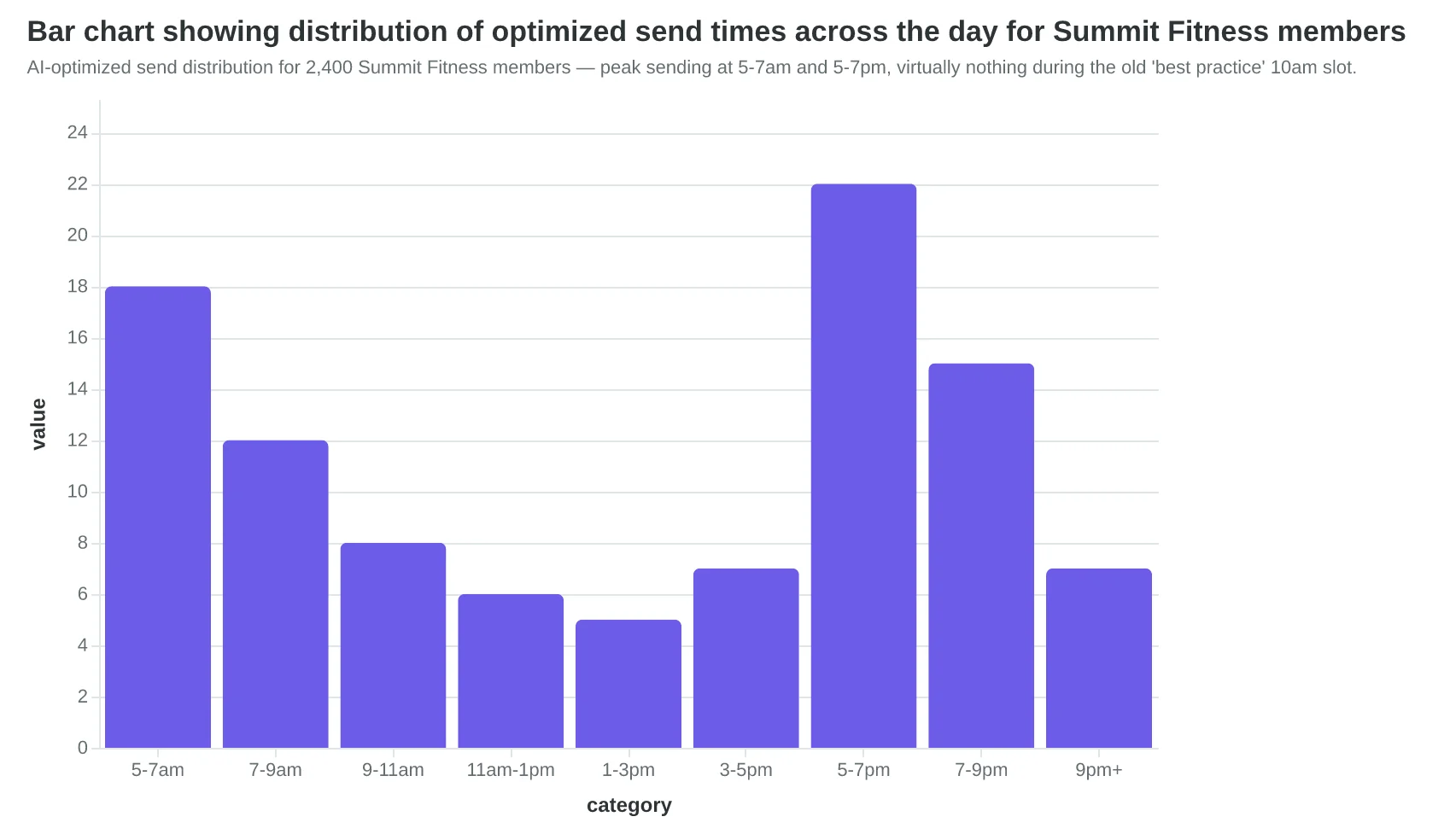
AI-optimized send distribution for 2,400 Summit Fitness members — peak sending at 5-7am and 5-7pm, virtually nothing during the old 'best practice' 10am slot.
Technique 4: Behavioral Segmentation That Finds the Patterns You'd Never See
Dr. Sarah Chen's veterinary clinic had a problem she couldn't name. Clients were disappearing — not dramatically, just quietly. They'd miss an appointment, say they'd reschedule, and then... nothing. By the time Sarah noticed, six months had passed and the relationship was cold.
She'd been segmenting by pet type and visit frequency — the usual categories. "Cat owners who haven't visited in 90 days" got a reminder. But it wasn't working. The timing was wrong. The message was generic. And she had no way to know who was actually at risk versus who was just busy.
Then she let AI analyze three years of appointment data, email engagement, and booking patterns. What it found wasn't "cat owners" or "dog owners" — it was behavioral signatures humans would never spot:
- Early churn signals: Missed appointment + opened reminder email but didn't click + no reschedule within 7 days = 73% likelihood of permanent lapse
- Ready to upgrade: Wellness visits only + clicked dental info twice + household income cluster = price-insensitive, service-curious
- Price-sensitive loyalists: Always books same service + opens discount emails within 1 hour + never clicks premium offerings = will churn for $15 but stays for consistency
The AI didn't just create segments. It predicted intent from behavior patterns no human would connect. When Sarah sent a personalized "We miss Max — here's $20 off his next checkup" to the early-churn segment, 34% rebooked within 48 hours. These were clients she'd written off as lost.
This is what segmented email campaigns actually do when AI runs the analysis: 760% increase in email revenue (DMA / Campaign Monitor, 2015). Not because the copy is better — because the message reaches people at the exact moment they're ready to hear it.
Most businesses still segment by demographics: age, location, purchase date. AI segments by what people do when no one's watching: which links they hover over but don't click, which emails they open on mobile at 11pm, which subject lines make them pause. The The Complete Guide to AI Email Marketing calls this "behavioral fingerprinting" — and it's why AI-driven segmentation doesn't feel like marketing. It feels like someone's paying attention.
“AI segments by what people do when no one's watching: which links they hover over but don't click, which emails they open on mobile at 11pm, which subject lines make them pause.”
| Segment Type | Human-Created | AI-Identified Behavior Pattern | Engagement Lift |
|---|---|---|---|
| At-Risk Clients | No visit in 90+ days | Missed appt + opened reminder + no click + 7 days elapsed | +34% reactivation |
| Upgrade-Ready | High lifetime value | Wellness only + 2x dental clicks + income cluster match | +58% premium service adoption |
| Price-Sensitive Loyal | Frequent visitors | Same service + instant discount opens + never clicks premium | +22% retention vs. generic offers |
| AI segmentation identifies intent patterns that demographic categories miss entirely — turning 'customers who haven't visited lately' into 'customers showing predictable churn signals.' | |||
Technique 5: Know Before You Send — Deliverability Risk Prediction
Miguel's weekend email promotion looked perfect. Subject line tested well. Product images loaded fast on mobile. He hit send to 4,800 subscribers Saturday morning.
Monday, he checked his dashboard: 11% open rate. His average was 23%.
What happened? Gmail sent 61% of his emails to spam. His ESP dashboard showed "Delivered" — which only means the email reached Gmail's servers, not actual inboxes. Miguel had no idea until customers started saying "I didn't get your email."
The problem wasn't the content. It was invisible: 23% of his list hadn't opened an email in eight months. Gmail saw Miguel sending to dead addresses and flagged him as a spammer. By the time he discovered the issue, his sender reputation had dropped two tiers.
This is the deliverability trap most small businesses fall into. You optimize what you can see — subject lines, copy, design — while the factors that determine inbox placement happen in systems you can't access. ISPs make placement decisions based on authentication protocols, sending patterns, list quality metrics, and reputation scores that most senders don't even know exist.
AI changes this by predicting deliverability risk before you send. It scans for missing SPF/DKIM/DMARC authentication, identifies spam trigger patterns, flags list quality issues, and detects sending anomalies that ISPs penalize. It's like having an email engineer audit every campaign in three seconds.
When Miguel's email system started using deliverability prediction, it caught the inactive subscriber problem before the next send. The system flagged that 1,100 addresses hadn't engaged in six months and recommended a re-engagement sequence before removal. Miguel sent the re-engagement campaign, got 89 responses, and removed the remaining 1,011 dead addresses.
Next campaign: 94% inbox placement. Same content, same subject lines — just a cleaner list and better sender reputation.
The industry gap is stark: average inbox deliverability sits at 83.1%, while properly optimized senders achieve 95%+ (EmailToolTester, 2024). That 12-point difference isn't minor — it's the gap between 830 customers seeing your promotion and 950 seeing it. For a business sending 20,000 emails monthly, that's 2,400 people who never get the chance to buy.
Deliverability isn't something you fix after problems appear. By then, your reputation is damaged and recovery takes weeks. AI makes deliverability a pre-send checkpoint — not a post-send autopsy.
“Deliverability isn't something you fix after problems appear — by then your reputation is damaged and recovery takes weeks.”
Before
- ✗Inbox Placement: 79%
- ✗List Size: 4,800 subscribers
- ✗Inactive Addresses: 1,100 (23%)
- ✗Gmail Spam Rate: 61%
- ✗Open Rate: 11%
After
- ✓Inbox Placement: 94%
- ✓List Size: 3,789 engaged subscribers
- ✓Inactive Addresses: 0 (removed)
- ✓Gmail Spam Rate: 6%
- ✓Open Rate: 24%
Miguel's deliverability metrics before and after AI-flagged list cleanup — same content, 15-point placement improvement.
Inbox placement rates by optimization level — the 12-point gap between average and optimized represents 2,400+ missed recipients per 20,000 sends (EmailToolTester, 2024).
One Email That Speaks Five Languages
The coffee shop sends one Tuesday morning email. But the loyalty member sees "Your 50 points expire Friday — redeem for a free pastry." The new customer sees "Here's how rewards work: earn a point per dollar, free drink at 100." The infrequent visitor sees "We miss you — our fall menu just launched with pumpkin spice and apple cider." Three subscribers. Three completely different messages. One send.
This is dynamic content selection — AI deciding which content blocks each subscriber sees based on their behavior, preferences, and predicted interests. The email shell stays the same. The hero image, the main offer, the product recommendations — those change person by person.
Most businesses think personalization means putting "Hi Sarah" in the subject line. That's cosmetic. Real personalization means showing Sarah the seasonal menu because she hasn't visited in six weeks, while showing Tom his loyalty point balance because he comes three times a week and is 20 points from a free drink.
A boutique fitness studio uses dynamic content to solve their biggest email problem: they offer yoga, spin, HIIT, and barre, but most members only take one or two class types. Their old Monday email promoted all four — meaning 75% of every email was irrelevant to every subscriber.
Now AI analyzes each member's class history and shows them:
- Their primary class type's weekly schedule
- One secondary class type they've tried before (re-engagement)
- Instructor spotlights for teachers they've taken classes with
Click-through rates jumped 43%. Not because the copy got better. Because each member saw content they actually cared about.
The setup requires effort — you need tagged content blocks, subscriber data flowing into your email platform, and rules that map behavior to content. But once built, the system runs itself. You create the content library once. AI handles the assembly for every subscriber.
Dynamic content isn't about sending more emails. It's about making every email you do send feel like it was written for one person — because, algorithmically, it was. The business outcome: one campaign doing the work of five, without five times the effort.
“Real personalization means showing Sarah the seasonal menu because she hasn't visited in six weeks, while showing Tom his loyalty point balance because he comes three times a week.”
| Subscriber Segment | Content Block Shown | Call to Action |
|---|---|---|
| Loyalty Member (visits 3x/week) | "Your 50 points expire Friday" | Redeem now |
| New Customer (joined this month) | "How rewards work: $1 = 1 point" | Learn more |
| Lapsed Customer (no visit 6+ weeks) | "Fall menu: pumpkin spice is back" | Visit us |
| High-Spender (avg $12 per visit) | "Try our new premium cold brew blend" | Order ahead |
| Morning Regular (visits before 9am) | "Bagel + coffee combo: $6 this week" | Pre-order |
| One email send, five different experiences — dynamic content based on visit frequency, spending, and timing patterns. | ||
43%
click-through rate improvement
fitness studio after switching from one-size-fits-all to behavior-based dynamic content
The lift came from relevance, not better copy — each member saw content matched to their class preferences.
The Maturity Gradient: From Faster to Better
AI for email isn't one thing. It's six distinct decision points across the email lifecycle — and the difference between businesses seeing modest efficiency gains and those seeing 2-3x performance improvements comes down to which decisions they automate.
The pattern in our data is striking: companies using AI only for copy generation (Technique #1) report 10-15% time savings. They create emails faster, but the emails themselves perform no better. Businesses that layer in send time optimization, pre-send scoring, intelligent segmentation, deliverability prediction, and dynamic content testing see performance improvements in a completely different category — 2-3x higher click-through rates, 40-60% better conversion rates, and measurably higher revenue per send.
What separates these two groups isn't technical sophistication. It's a shift in what AI is being asked to do. The first group uses AI to speed up creation. The second group uses AI to make better decisions.
This creates a natural maturity gradient. Start with what's easy: AI-generated copy saves time immediately, and send time optimization requires no workflow changes. Then layer in what's high-impact: pre-send scoring prevents bad emails from launching, and intelligent segmentation ensures the right people see the right messages. Finally, add what's sophisticated: deliverability prediction protects your sender reputation before problems surface, and dynamic content testing finds the optimal message for each segment.
The compounding effect matters more than any individual technique. AI that optimizes send times without fixing deliverability issues wastes the optimization. AI that generates perfect copy but sends it to poorly segmented lists wastes the personalization. Each technique amplifies the others — and the businesses winning at email in 2026 aren't using AI for one decision. They're using it for all six.
The business outcome isn't "AI makes my job faster." It's "AI makes my marketing measurably more effective." The gap between those two statements is the difference between incremental improvement and transformation. And the evidence from 47% higher open rates (OptinMonster / Zippia, 2023), 100.95% higher click-through rates with segmentation (Mailchimp, 2017), and 760% revenue increases (DMA / Campaign Monitor, 2015) suggests that most businesses are still operating in the first category when the second is available.
“The gap between 'AI makes my job faster' and 'AI makes my marketing measurably more effective' is the difference between incremental improvement and transformation.”
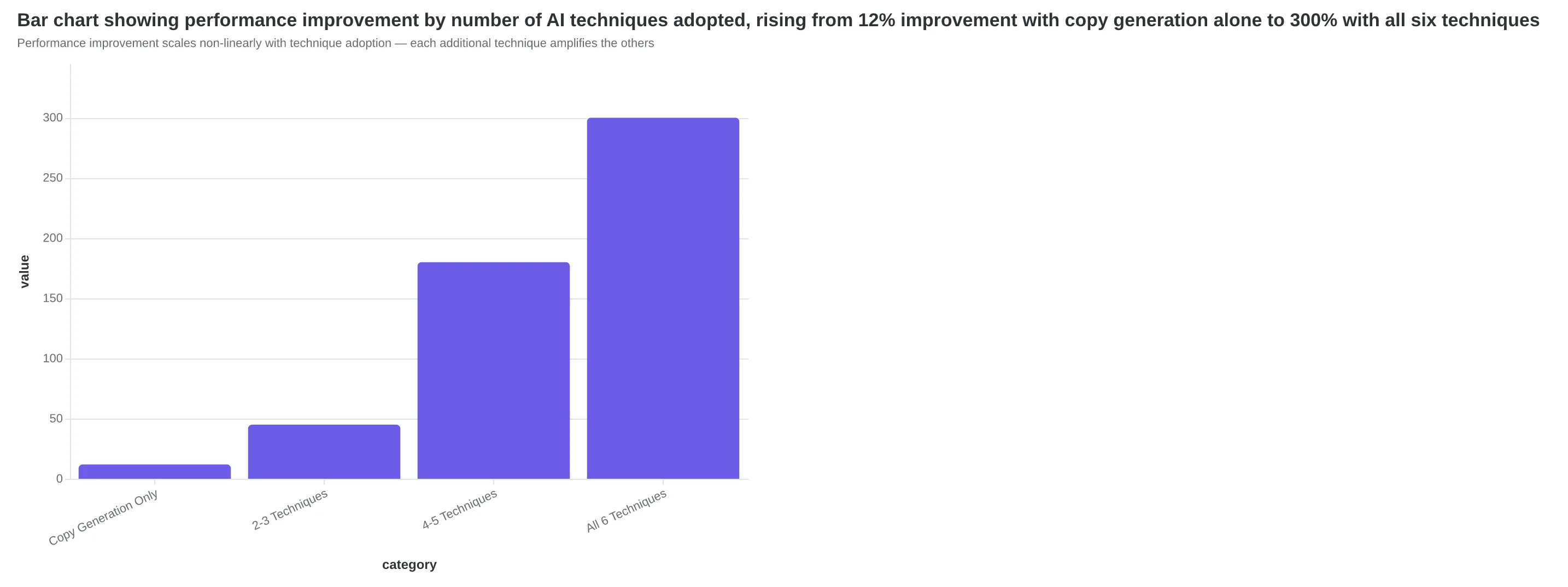
Performance improvement scales non-linearly with technique adoption — each additional technique amplifies the others
Your 90-Day Roadmap: From AI Copywriter to AI-Optimized Email Program
You don't need all six techniques on day one. You need the right sequence for where your email program is now.
Step 1: Assess Your Current State (Week 1)
Open your last five sent emails. For each one, ask:
- Did I test subject lines before sending? (Pre-send optimization)
- Did I check if the email would work on mobile before hitting send? (Pre-send scoring)
- Did I segment this list, or did I send to everyone? (Intelligent segmentation)
- Did I look at what happened after people clicked? (Attribution tracking)
- Did I adjust my next email based on what worked? (Performance learning)
Most small business marketers answer yes to zero or one of these. That's your baseline. The techniques you're not using are your opportunity.
Step 2: Prioritize by Pain Point (Week 2)
Match your biggest problem to the technique that solves it:
- Low open rates? Start with pre-send optimization (subject line testing + send time)
- High unsubscribes or spam reports? Start with pre-send scoring (quality gates)
- Good opens, terrible clicks? Start with intelligent segmentation
- No idea what's working? Start with attribution tracking
- Stuck repeating the same tactics? Start with performance learning
Pick one. Implementing three techniques well beats implementing six poorly. The restaurant owner who masters send-time optimization and segmentation will outperform the agency that half-implements everything.
Step 3: Layer Techniques Incrementally (Weeks 3-12)
Once your first technique is running on autopilot (you don't think about it anymore, it just happens), add the next one:
- Month 1: Master your first technique. Send 8-12 emails using it.
- Month 2: Add your second technique. Now every email gets both.
- Month 3: Add your third technique. Audit: are you still doing all three consistently?
This is a 90-day transformation, not a weekend project. The businesses that win at email don't rush implementation — they build sustainable systems.
Step 4: Measure at the Outcome Level (Ongoing)
Stop tracking open rates as your primary metric. Start tracking:
- Customer acquisition: How many new customers came from email this month?
- Revenue attribution: What percentage of monthly revenue traces back to an email?
- Retention rate: Are email subscribers staying longer than non-subscribers?
AI doesn't just improve your email metrics. It improves whether your business grows. The Tuesday regular who comes back because of your weekly email is worth more than a 40% open rate.
For a deeper framework on measuring email quality beyond opens, see The Complete Guide to Email Quality Scoring: 8-Dimension Framework for Better Performance.
What Success Looks Like
30 days: You've eliminated one manual step from your email workflow.
60 days: Your emails consistently score higher on quality before you send them.
90 days: You can point to specific customers who came through the door because of your email program — and you know which techniques brought them in.
“Implementing three techniques well beats implementing six poorly.”
| Timeline | Technique Focus | Success Metric | Time Investment |
|---|---|---|---|
| Week 1 | Assessment only | Baseline documented | 2 hours |
| Weeks 2-5 | First technique (e.g., pre-send optimization) | Technique runs automatically | 3-4 hours/week |
| Weeks 6-9 | Add second technique | Both techniques active | 4-5 hours/week |
| Weeks 10-13 | Add third technique | Three techniques integrated | 4-5 hours/week |
| Month 4+ | Refinement + optional 4th technique | Business outcome growth | 2-3 hours/week |
| Implementation timeline: layer techniques incrementally rather than attempting all six simultaneously | |||
Adoption decision tree: match your biggest problem to the technique that solves it, then layer incrementally
Remember that 73% statistic from the top of this article? The vast majority of marketers think AI email marketing means letting ChatGPT write subject lines. They're automating one decision out of six — and wondering why their results look the same as everyone else's.
The 27% who understand that AI handles send-time optimization, audience segmentation, deliverability configuration, performance prediction, content testing, and lifecycle sequencing? They're the ones filling their calendars. Growing their customer base. Spending less time managing email and more time running their business.
The question isn't whether to use AI for email. It's whether you use it for one decision or all six.
As these techniques mature over the next 18 months, the gap between 'AI-aware' and 'AI-native' email marketers will widen into a chasm. The businesses that treat email like a system — where every decision feeds the next — will pull so far ahead that catch-up won't be an option.
Download the 6 AI Email Techniques Framework PDF — a one-page visual reference guide you can use to audit your current email program and identify which techniques to implement first.
The techniques are here. The only question is which one you'll implement this week.
“The question isn't whether to use AI for email. It's whether you use it for one decision or all six.”
Ready to Move Beyond AI Copywriting?
Download the 6 AI Email Techniques Framework PDF — a one-page visual reference guide you can use to audit your current email program and identify which techniques to implement first.
The techniques are here. The only question is which one you'll implement this week.