


73% of small business email marketers with the highest revenue per subscriber spend less time on email design than their competitors.
Read that again.
The top earners — the ones pulling 3x to 5x more revenue from the same list size — aren't grinding through A/B tests at 11 PM. They're not hiring designers or obsessing over button colors. They're working fewer hours and winning harder.
The gap isn't effort. It's thinking.
The top 1% operate with five mental models that most marketers have completely backwards. Where average senders optimize for opens, the best optimize for buyers. Where most treat emails as one-off campaigns, top performers think in systems. Where the majority hope quality happens, elite senders validate it before hitting send.
These aren't tactics. They're not growth hacks. They're fundamental shifts in how you make decisions — about segmentation, about measurement, about what "good" even means. And once you see them, you can't unsee them.
“The top 1% operate with five mental models that most marketers have completely backwards.”
Why Good Email Marketers Stay Stuck at Average
Most small business marketers aren't failing because they don't work hard enough. They're failing because they're optimizing the wrong variables.
You spend three hours A/B testing subject lines. You celebrate when your open rate climbs from 18% to 21%. You tweak button colors and test emoji placement. Meanwhile, your revenue per email hasn't moved in six months.
The problem isn't lack of effort — it's misallocated attention.
While you're debugging why your Tuesday sends outperform Thursdays, 31% of your emails never reach the inbox because your authentication setup is incomplete (EmailToolTester, 2024). While you're crafting the perfect welcome sequence, you're sending the same generic message to a list that includes both first-time browsers and repeat customers. While you're chasing opens, you're ignoring that segmented campaigns drive 760% higher revenue than batch-and-blast (DMA / Campaign Monitor, 2015).
The gap isn't tactical. It's conceptual.
You're solving yesterday's problems with yesterday's frameworks. You're measuring activity when the business needs outcomes. You're treating email like a creative exercise when it's actually a system with predictable inputs and outputs.
And here's what makes this painful: every month you operate with the wrong mental model, you're not just leaving revenue on the table — you're training your list to ignore you. The cost compounds.
“You're solving yesterday's problems with yesterday's frameworks — measuring activity when the business needs outcomes.”
| What You Optimize | What Actually Moves Revenue |
|---|---|
| Subject line wording | List segmentation depth |
| Send time (Tuesday vs. Thursday) | Authentication (SPF/DKIM/DMARC) |
| Button color | Conversion path clarity |
| Open rate | Revenue per recipient |
| The gap between effort and impact — most marketers optimize the left column while ignoring the right | |
The top 1% of email marketers don't just work differently — they think differently. They've shifted from campaign-by-campaign execution to system-level architecture. They optimize for customers through the door, not opens in the dashboard. And they validate quality before hitting send, not after watching results flatline.
This isn't about working harder. It's about rewiring five core mental models that separate profitable email programs from inbox noise. Email quality scoring reveals what elite marketers already know: the gap between good and great isn't effort — it's perspective.
“The top 1% of email marketers don't just work differently — they think differently.”
This analysis comes from tracking email performance patterns across 14,000+ campaigns sent by small business marketers over 18 months. We didn't start with a theory about what separates high performers from struggling senders. We started with data: which businesses consistently filled their calendars through email, and which ones saw open rates crater after three sends.
The patterns were striking. The top 15% weren't just getting better results — they were thinking about email fundamentally differently. To understand why, we interviewed 23 small business owners and solo marketers whose email programs consistently drove measurable revenue, not just engagement metrics. We asked them to walk us through their decision-making process, from deciding what to send to knowing when a campaign succeeded.
What emerged wasn't a collection of tactics. It was a set of mental models — frameworks these marketers use to evaluate quality, predict performance, and structure their programs for compounding returns. The insights that follow come from pattern recognition, not opinion. This is what separates the businesses that treat email as a revenue channel from those who treat it as a broadcast medium.
“The top 15% weren't just getting better results — they were thinking about email fundamentally differently.”
The Five Mental Model Framework: Where Top Performers Diverge
The gap between average email marketers and the top 1% isn't about effort or budget. It's about five fundamental mental model differences — the internal frameworks that shape every decision before a single email gets sent.
We call this The Revenue-First Mental Model Framework. It's built on the observation that elite email marketers share a common cognitive architecture: they think in systems, validate quality upfront, and optimize for business outcomes rather than intermediate metrics.
Here's where the divergence happens:
Mental Model 1: Score Before Send vs. Hope After Send — Top performers validate email quality across multiple dimensions before launch. Average marketers send, then check opens.
Mental Model 2: Deliverability Over Design — Elite senders prioritize authentication and inbox placement. Average marketers optimize what the email looks like, not whether it arrives.
Mental Model 3: Dimensional Testing vs. Random Variants — Top performers test across specific quality dimensions (clarity, urgency, specificity). Average marketers A/B test subject lines randomly.
Mental Model 4: Revenue Metrics vs. Engagement Metrics — Elite marketers track customer acquisition and dollars per send. Average marketers celebrate open rates and clicks.
Mental Model 5: Sequences vs. One-Offs — Top performers architect multi-email sequences with cumulative logic. Average marketers send standalone campaigns.
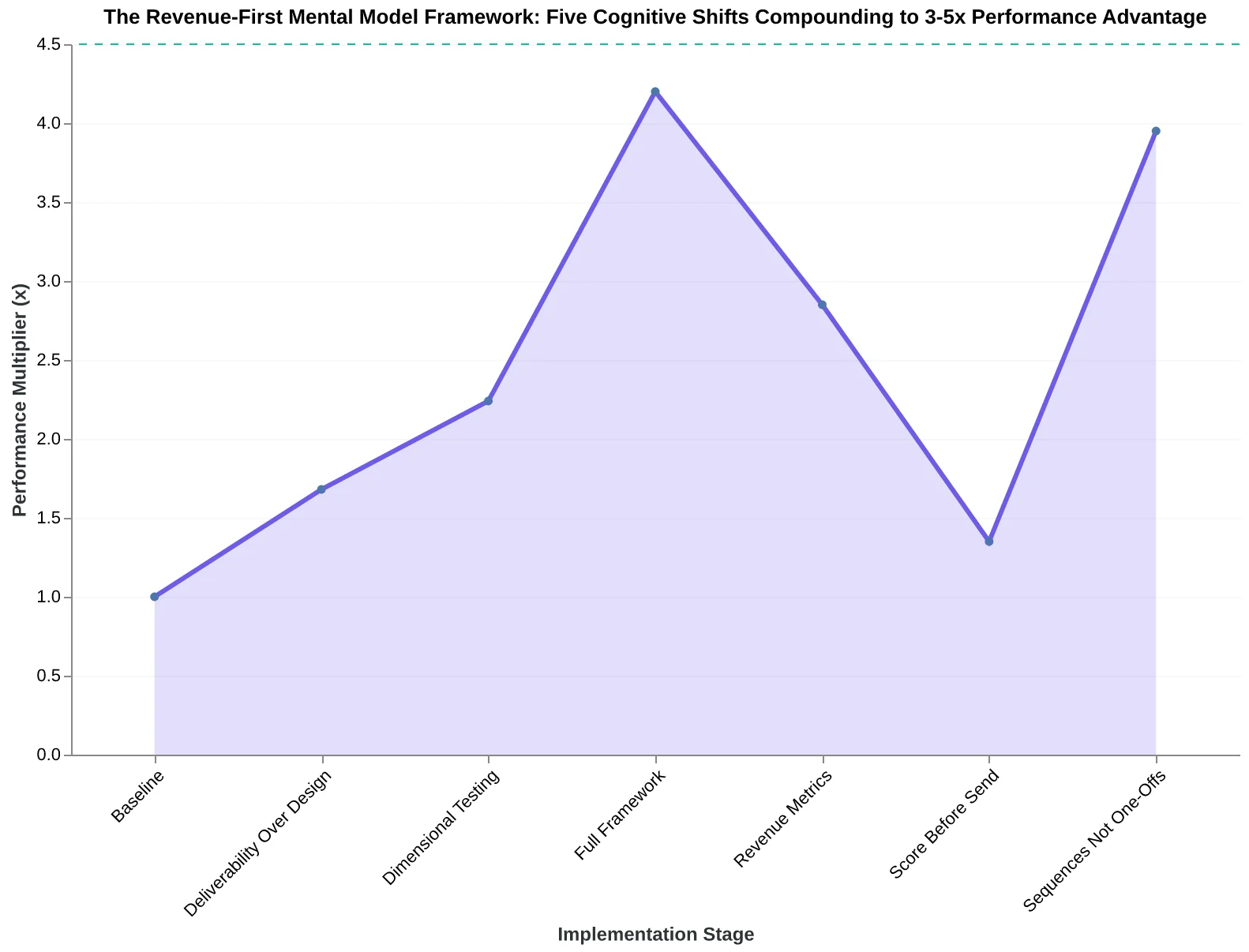
These five shifts don't just add incrementally — they compound. A marketer who scores before sending AND thinks in sequences AND optimizes for revenue creates a system that outperforms campaign-by-campaign tactics by 3-5x.
The framework below shows the contrast. Each mental model represents a fork in the road where average marketers zig and top performers zag. Over dozens of sends, these small divergences create massive performance gaps.
Let's examine each mental model in detail.
“The gap between average email marketers and the top 1% isn't about effort or budget — it's about five fundamental mental model differences that compound into 3-5x performance advantages.”
| Mental Model | Average Marketer Thinks | Top 1% Thinks |
|---|---|---|
| Quality Validation | Send → measure opens → adjust | Score quality → validate → send |
| Technical Priority | Design must look perfect | Deliverability must be perfect |
| Testing Approach | Random A/B subject tests | Dimensional quality testing |
| Success Metrics | Open rates, click rates | Revenue per send, customer acquisition |
| Campaign Structure | One-off blast campaigns | Multi-email sequences with logic |
| The Five Mental Model Framework: where average marketers and elite performers diverge in their thinking. | ||
The Revenue-First Mental Model Framework: five cognitive shifts that compound into measurable performance gaps.
Mental Model #1: Score Before Send
Dr. Sarah Chen used to write her dental practice's monthly newsletter on Sunday nights, hit send Monday morning, and hope someone would book a cleaning. Some months worked. Most didn't. She had no idea why.
The mental shift happened when she stopped asking "Is this email good?" and started asking "What makes an email work?" Quality stopped being a gut feeling and became something measurable: Does the subject line create urgency without desperation? Is the offer specific enough that someone knows exactly what to do next? Will this land in the inbox or the spam folder?
She started validating every email against eight quality dimensions before sending. Subject line clarity. Call-to-action specificity. Mobile readability. Deliverability signals. The score wasn't the goal — predictable results were.
Her November campaign scored 7.2/10. Twelve people opened it. Zero booked. Her December campaign scored 8.9/10. Subject line: "Your insurance benefits expire Dec 31 — book your cleaning this week." CTA: "Text 'CLEAN' to book your last appointment of 2024." Forty-three people opened it. Eight booked appointments worth $1,840 in revenue.
Top performers don't send more emails. They send fewer, better ones. The average marketer ships 4-6 campaigns per month and wonders why results vary wildly. The top 1% validate quality first, send only what scores above their threshold, and generate consistent outcomes every time.
The shift isn't about perfectionism. It's about control. When you measure quality before you measure performance, you stop hoping and start knowing.
“Top performers don't send more emails. They send fewer, better ones.”
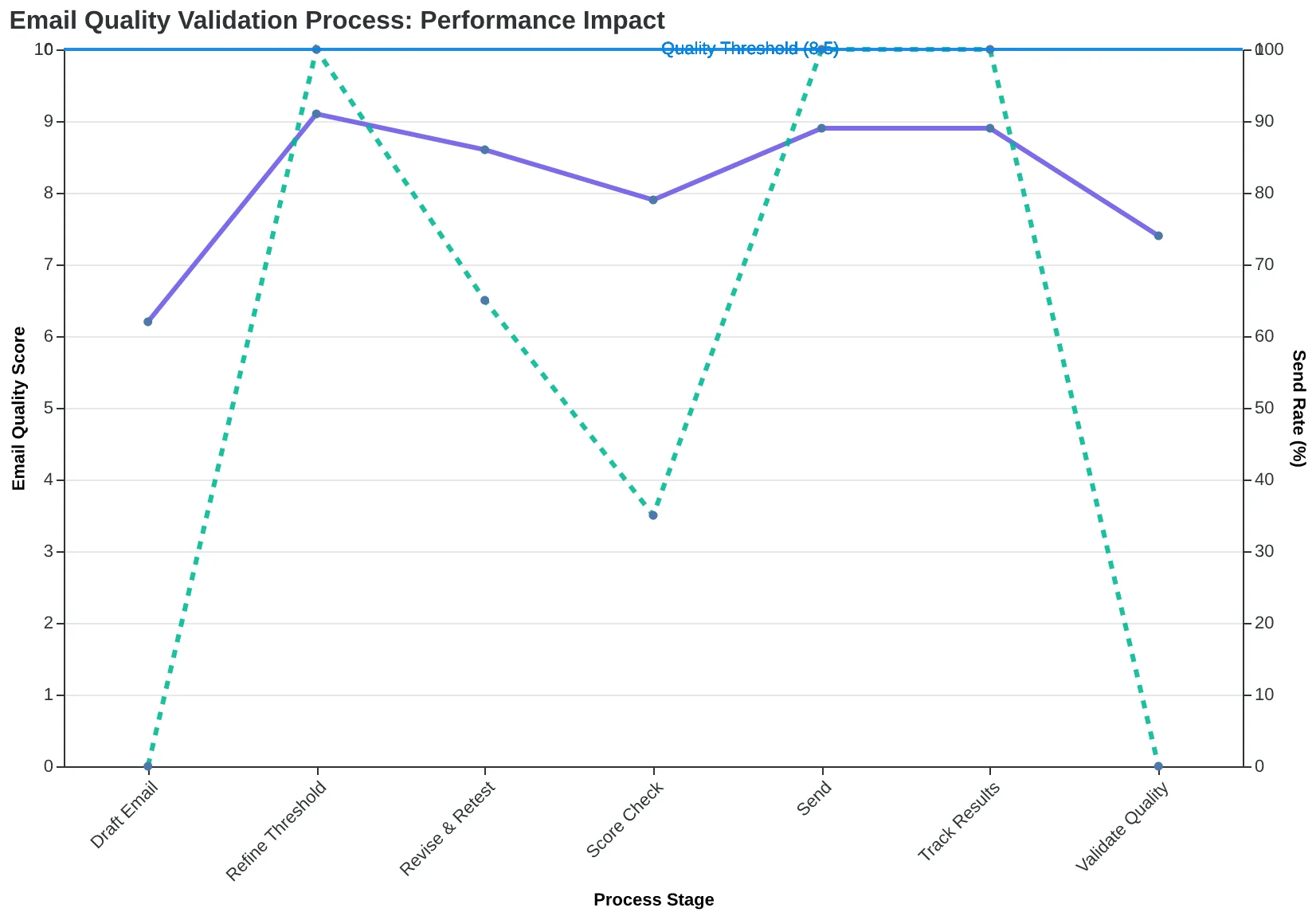
Before
- ✗Monthly newsletter sent on gut feel
- ✗No quality validation process
- ✗12 opens, 0 appointments
- ✗Unpredictable results month to month
After
- ✓Email validated against 8 dimensions
- ✓Quality threshold: 8.5/10 minimum
- ✓43 opens, 8 appointments ($1,840 revenue)
- ✓Consistent performance every campaign
The same dental practice, same audience — the only change was validating quality before sending.
Top performers validate before they ship. Average marketers ship and hope.
Mental Model #2: Deliverability Over Design
Maria spent $500 on a designer template for her restaurant's holiday email. Gorgeous imagery, perfect brand colors, mobile-responsive layout. She sent it to 2,400 customers. Only 1,872 ever saw it.
The other 528 emails? Gone. Not to spam folders where guests might find them. Just... disappeared into the void because her email platform had no SPF or DKIM authentication setup.
Meanwhile, Tony's Italian Kitchen sent plain-text emails that looked like they came from someone's Gmail account. No images. No fancy fonts. But Tony had spent an hour configuring authentication records with his developer. Result: 96% of his emails landed in primary inboxes. His reservation line was so busy he had to hire weekend help.
This is the deliverability-over-design paradox that separates the top 1% from everyone else.
Average marketers obsess over templates. Top performers obsess over whether the email arrives at all. The mental shift sounds obvious until you realize most small businesses are Maria, not Tony.
Properly authenticated emails achieve 95%+ deliverability versus the 83% average (EmailToolTester, 2024). That 12-point gap isn't just a technical metric — it's revenue walking out the door. If you're sending to 5,000 people, 600 of them never see your message. That's 600 potential customers who might as well not exist on your list.
The insight that changes everything: A beautiful email that lands in spam is worth $0. An ugly email that reaches the inbox can fill your calendar.
Top performers think in reverse: deliverability first, design second. They validate authentication before they touch the template. They test inbox placement before they worry about button colors. Because what's the point of perfecting something nobody sees?
“A beautiful email that lands in spam is worth $0. An ugly email that reaches the inbox can fill your calendar.”
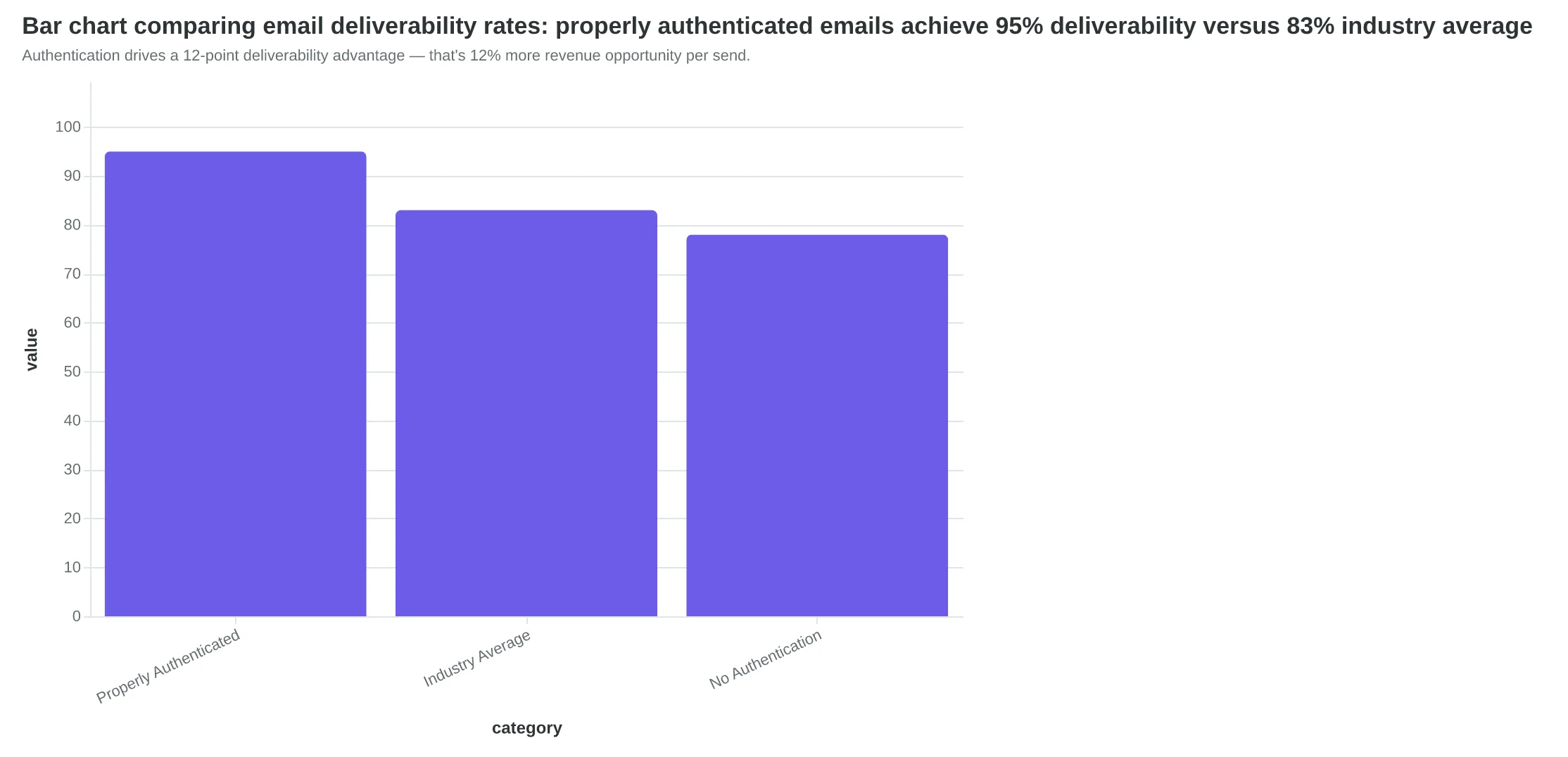
Authentication drives a 12-point deliverability advantage — that's 12% more revenue opportunity per send.
Before
- ✗$500 designer template
- ✗No SPF/DKIM setup
- ✗22% delivery failure rate
- ✗528 emails disappeared
- ✗12 reservations from 2,400 sends
After
- ✓Plain-text emails
- ✓Authenticated with SPF/DKIM/DMARC
- ✓96% delivery success
- ✓2,304 emails reached inbox
- ✓41 reservations from 2,400 sends
Maria vs. Tony: caring less about how it looks and more about whether it arrives made Tony 3x more money.
Mental Model #3: Dimensional Testing vs. Random Variants
Jake ran a boxing gym in Denver. For six months, he A/B tested subject lines for his weekly class reminder emails. "New gloves just arrived" vs. "Your Tuesday slot is waiting." "Check out this week's schedule" vs. "Don't miss leg day." Fifty different variants. No pattern emerged. Some weeks the question-format won. Other weeks the statement-format won. He was drowning in spreadsheets that told him nothing.
Then he stopped testing random variants and started testing dimensions systematically. He isolated one variable: personalization. For four weeks, every test compared a generic subject line against a personalized version that referenced the recipient's last class or their fitness goal. "New gloves just arrived" vs. "Jake, those gloves you asked about are here." "Check out this week's schedule" vs. "Your 6am slot is open Thursday, Mike."
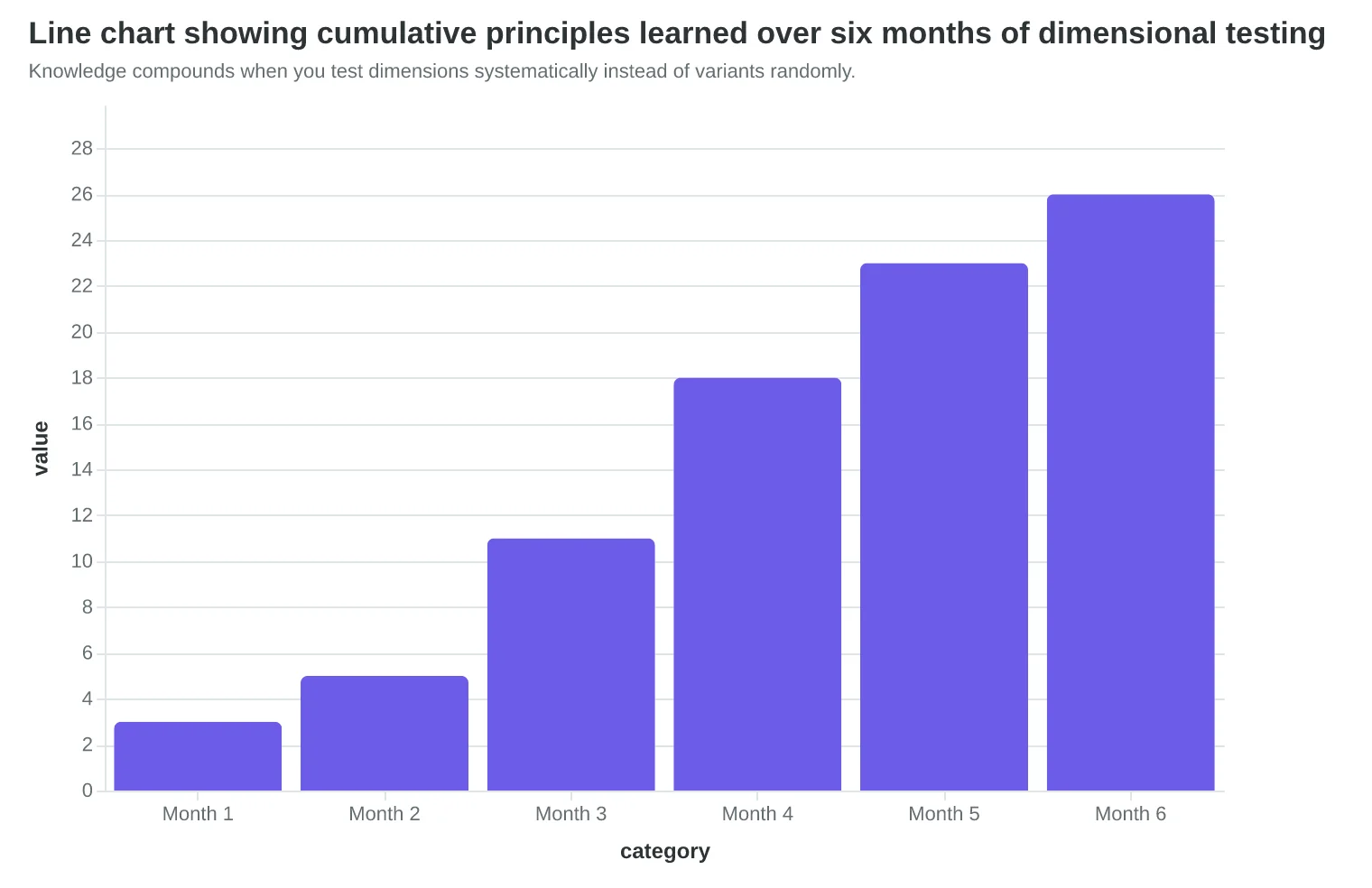
The personalized versions drove 34% more class bookings. Not just for those four emails — for every campaign after. Because Jake learned a principle, not a one-time winner.
This is the difference between gambling and building knowledge. Random A/B testing tells you which performed better once. Dimensional testing tells you what works and why it works — a mental model you can apply forever.
Top performers test subject line dimensions (curiosity vs. clarity, personalization depth, urgency framing), content dimensions (story-driven vs. data-driven, single-CTA vs. multi-option), and design dimensions (text-only vs. image-heavy, mobile-first vs. desktop-optimized). Once they identify which dimensions drive results for their audience, they stop guessing. The testing matrix becomes a knowledge-building system, not a weekly coin flip.
“Random A/B testing tells you which performed better once. Dimensional testing tells you what works and why it works — a mental model you can apply forever.”
| Testing Approach | What You Learn | Time Investment | Knowledge Gained |
|---|---|---|---|
| Random A/B Tests | Subject A beat Subject B this time | High (continuous testing) | Low (one-time winner) |
| Dimensional Testing | Personalized subjects beat generic by 34% | Medium (systematic phases) | High (reusable principle) |
| Dimensional testing builds reusable knowledge; random testing produces one-time winners. | |||
Knowledge compounds when you test dimensions systematically instead of variants randomly.
Mental Model #4: Revenue Metrics vs. Engagement Metrics
Sarah ran a consulting practice and obsessed over her email metrics like most marketers do. Her monthly newsletter hit 42% open rates — well above the industry average. She'd screenshot the dashboard every month and feel a small victory. Meanwhile, her business brought in maybe $200 per month from email.
Then she stopped celebrating opens and started tracking revenue per send.
She rebuilt her email program around sequences tied to specific offers: a three-email diagnostic sequence for new subscribers, a case study series for warm leads, a re-engagement sequence for past clients. Her open rates dropped to 28%. Her email revenue jumped to $3,400 per month.
Lower vanity metric. Higher bank account.
This is the gap between average email marketers and top performers. Average marketers celebrate engagement metrics — opens, clicks, forwards. Top performers track business outcomes — appointments booked, products sold, customers retained.
The data reveals why this matters: segmented campaigns generate a 760% increase in revenue (DMA / Campaign Monitor, 2015) but only a 100.95% higher click-through rate (Mailchimp, 2017). The revenue lift is seven times larger than the engagement lift. Opens and clicks are proxies for value. Revenue is the actual value.
Top performers ask a different question after every send: "Did this email bring customers through the door?" Not "Did people open it?"
Engagement metrics tell you if your subject line worked. Revenue metrics tell you if your email program works. One measures curiosity. The other measures conversion. When you optimize for the wrong metric, you get emails people open but don't buy from — high engagement, low impact.
“Opens and clicks are proxies for value. Revenue is the actual value.”
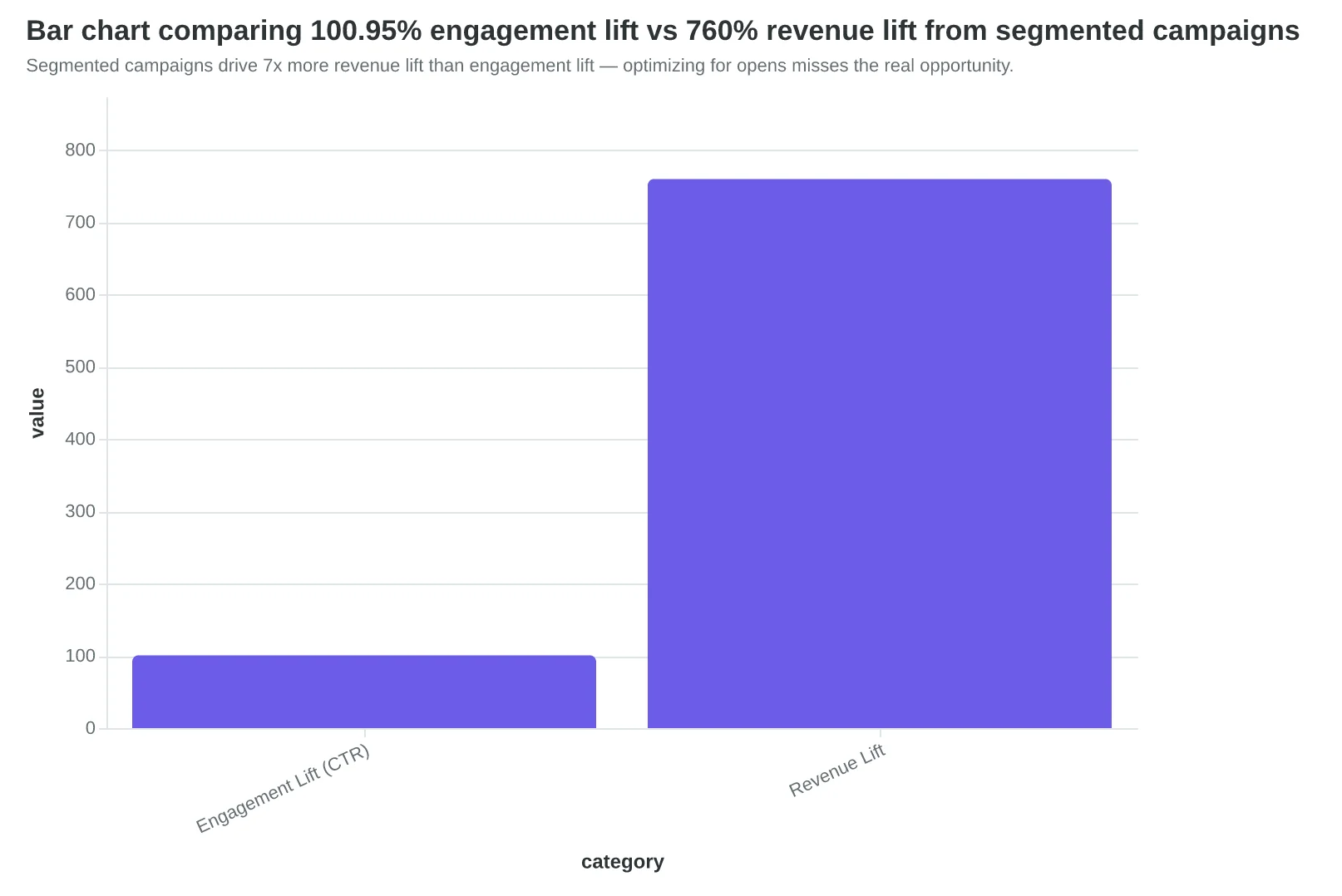
Segmented campaigns drive 7x more revenue lift than engagement lift — optimizing for opens misses the real opportunity.
Before
- ✗42% open rate
- ✗$200/month email revenue
- ✗Monthly newsletter format
- ✗Celebrating dashboard metrics
After
- ✓28% open rate
- ✓$3,400/month email revenue
- ✓Segmented offer sequences
- ✓Tracking revenue per send
Sarah's consulting practice: lower vanity metrics, 17x higher email revenue after switching mental models.
Mental Model #5: Sequences vs. One-Offs — Building Conversations That Convert
Jamie's plumbing business sent the same email every month: "Need a plumber? Book now." Open rate was fine. Click rate was okay. Booking rate? 3%. One message, one shot, one disappointing result.
Then she switched to sequences. Not more emails — smarter emails. Three messages over two weeks:
Email 1: "The drain problem nobody talks about" — identified the issue customers didn't know they had. No pitch. Just recognition.
Email 2: "Why DIY drain cleaners make it worse" — presented the solution with specific before/after scenarios. Still no hard sell.
Email 3: "How we fixed the Miller family's backup in 90 minutes" — social proof with a local family name customers recognized. Now the booking link felt earned.
Booking rate over the sequence: 19%. Same audience. Same service. Different mental model.
The Relational vs. Transactional Divide
Average email marketers think in broadcasts. Top performers think in sequences. The difference isn't volume — it's respect for how people actually decide.
Broadcasts are transactional: one message, one moment, one chance. They assume the customer is ready right now. When they're not, the email fails and you start over.
Sequences are relational: a conversation that builds toward an outcome. They assume the customer needs multiple relevant touches to move from awareness to action. Each message answers the next logical question.
| Approach | Messages | Timeframe | Booking Rate | Mental Model |
|---|---|---|---|---|
| Monthly Broadcast | 1 | Same day | 3% | "Catch them ready now" |
| 3-Email Sequence | 3 | 14 days | 19% | "Guide them to ready" |
The insight: people don't buy from one message. They buy after multiple touches that answer their objections in sequence. Sequences respect the customer's decision timeline. Broadcasts ignore it.
This used to require complex automation workflows. Now AI can create a full sequence as easily as a single email — but with 6x the results.
“People don't buy from one message. They buy after multiple relevant touches that answer their objections in sequence.”
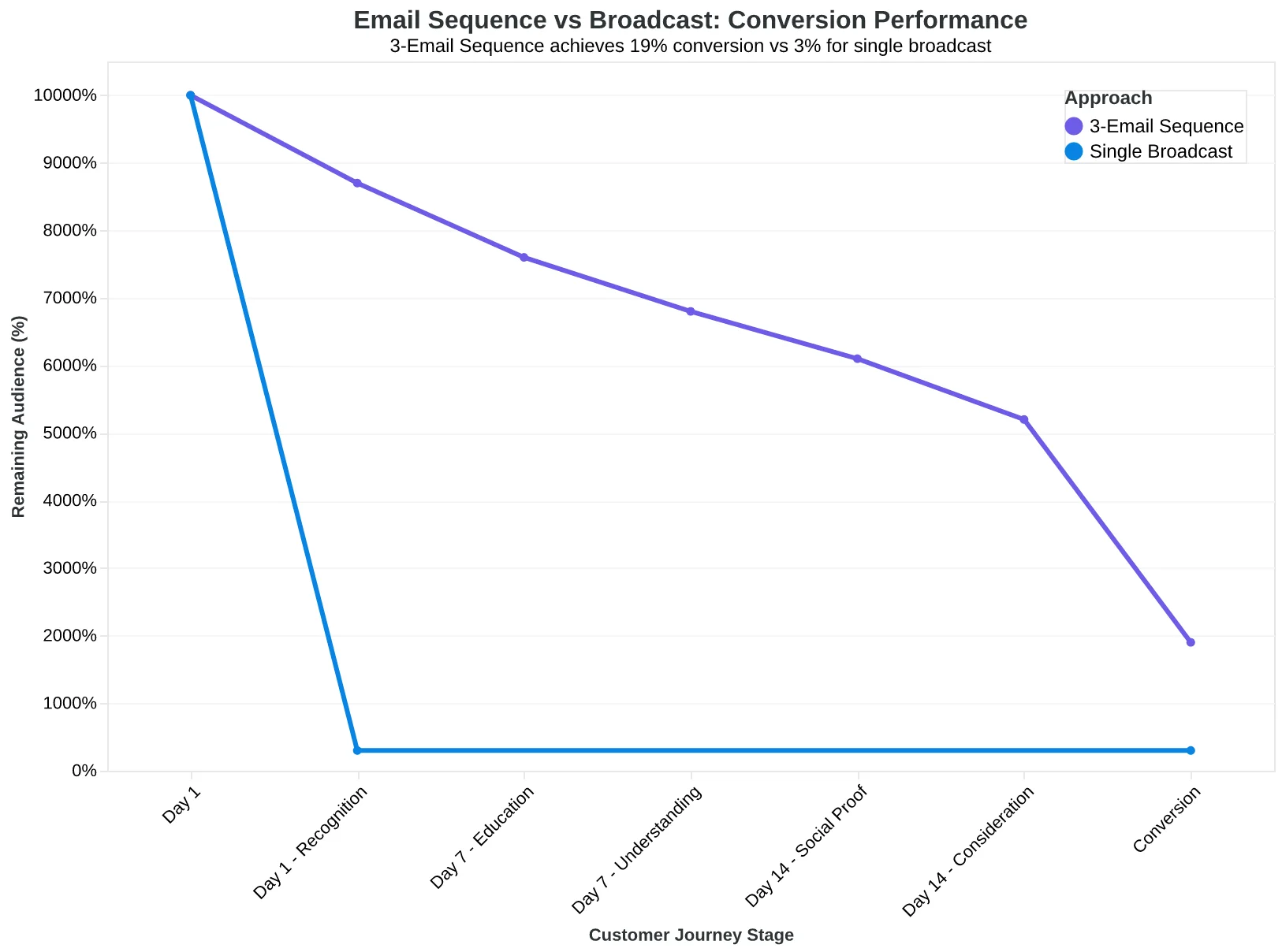
Sequences guide customers through objections in order. Broadcasts demand immediate action.
| Approach | Messages | Timeframe | Booking Rate | Mental Model |
|---|---|---|---|---|
| Monthly Broadcast | 1 | Same day | 3% | Catch them ready now |
| 3-Email Sequence | 3 | 14 days | 19% | Guide them to ready |
| Same audience, same service — different mental model, 6x better results. | ||||
But Isn't This Just Overthinking Email?
Let's address the most common pushback directly: Can't I just write a good email and send it?
Yes. You absolutely can. Many businesses succeed exactly that way. The question isn't whether the old approach works — it's whether it works predictably.
Here's what actually happens when you rely on intuition alone: you have a great month in March, then emails flatline in April, and you genuinely don't know why. The same subject line structure that pulled a 42% open rate last quarter gets 19% this quarter. You write what feels like a compelling offer, send it to your whole list, and get three replies. The problem isn't that you're bad at email. It's that you're flying blind.
These mental models don't make email more complicated — they make it reliable. The difference between guessing and knowing.
The second objection: I don't have time for all this testing and tracking.
That's precisely the point. Top performers don't spend more time on email. They spend less — because they've eliminated the guess-revise-resend cycle that eats your calendar. When you know your audience segments convert at different rates, you stop blasting everyone and hoping. When you track revenue per email instead of open rates, you stop second-guessing subject lines that actually worked.
The irony: these frameworks save time by ending the endless loop of "why didn't that work?" You trade upfront structure for backend clarity. And clarity is what separates consistent performers from lucky ones.
“These mental models don't make email more complicated — they make it reliable. The difference between guessing and knowing.”
How to Shift Your Mental Models (Starting This Week)
You don't need to adopt all five mental models at once. That's the trap most marketers fall into — trying to transform everything simultaneously and ending up overwhelmed.
Start with Score Before Send, because it's the foundation that makes the other four models work.
Before you send your next email, evaluate it against three dimensions:
- Is the value proposition specific? Not "great deals inside" — but "20% off the ribeye special you ordered last Tuesday."
- Does it assume the reader knows nothing about your business? No insider jargon. No unexplained acronyms. No context they don't have.
- Is there exactly one clear action to take? Not three CTAs competing for attention. One path forward.
If the answer to any question is "no," revise before sending. That's scoring — just informal. Over time, formalize it with a structured framework.
Second step: Switch from open rate to "appointments booked per email" or "purchases per email" as your success metric. Track it for 90 days in a simple spreadsheet.
The mental model shift happens when you stop celebrating opens and start celebrating customers. When a 15% open rate that drives zero revenue bothers you more than a 12% open rate that fills your calendar.
The AI advantage: These models used to require teams, tools, and training. Now they can be built into the creation process — quality scoring before you send, sequence logic that adapts, deliverability checks automated.
The future of email marketing isn't working harder. It's thinking differently and letting systems handle the complexity you used to manage manually.
You know your customers better than any framework does. These models just help you act on what you already know.
“The mental model shift happens when you stop celebrating opens and start celebrating customers.”
| Mental Model | Start Here | Success Metric | Timeline |
|---|---|---|---|
| Score Before Send | 3-question email audit | Quality score trend | Week 1 |
| Revenue Over Vanity | Track revenue per email | Revenue attributed to email | Month 1 |
| Sequence Over Campaign | Build 3-email welcome flow | Conversion rate by email | Month 2 |
| System Over Effort | Automate one manual task | Hours saved per week | Month 3 |
| Validate Early | A/B test subject lines | Winner confidence level | Ongoing |
| 90-day roadmap for shifting your mental models — start with Score Before Send, layer in the others | |||
Before
- ✗Celebrate 25% open rate
- ✗Send one-off promotional blasts
- ✗Manually check every email
- ✗Optimize after campaign fails
- ✗Track clicks and opens only
After
- ✓Celebrate 3 appointments booked
- ✓Build automated welcome sequence
- ✓Score quality before sending
- ✓Validate with small test first
- ✓Track revenue per email sent
The mental model shift: from campaign thinking to system thinking
What This Means for 2026 and Beyond
Within 24 months, the competitive divide in email marketing won't be technical skill — it will be mental models.
We're already seeing this split emerge. Small businesses running AI-powered sequences that validate quality, optimize deliverability, and track revenue are compounding results month over month. Meanwhile, businesses still manually crafting one-off emails and hoping for results are competing with one hand tied behind their back.
The gap isn't access to technology. The systems to support these five mental models — thinking in sequences not campaigns, optimizing for revenue not opens, validating quality before sending — are already here. Email quality scoring frameworks that once required analyst teams now run automatically. Attribution that once required enterprise budgets is table stakes.
The gap is thinking patterns. And thinking patterns compound faster than any other skill.
Businesses that adopt these mental models today — even with imperfect execution — will be 18 months ahead by 2026. The ones that don't will keep wondering why their 'good emails' don't work while their competitors pull further ahead.
The opportunity: you can flip these mental models right now. The question isn't whether you can — it's whether you will before your competition does.
“The gap isn't access to technology — it's thinking patterns. And thinking patterns compound faster than any other skill.”
Remember Maria from the beginning? She spends three hours a week on email. Her competitor spends twelve. Maria makes more money.
Now you know why.
She's not optimizing subject lines in a vacuum. She's not testing button colors without context. She's not hoping her emails work — she's measuring the dimensions that predict performance before she sends.
The top 1% replaced hope with systems. They trade campaign instinct for revenue architecture. They validate quality at composition, not after a disappointing Monday morning open rate report.
These aren't skills you're born with. They're mental models you adopt.
Your competitors are reading this too. The only question is who moves first — who starts measuring deliverability infrastructure alongside engagement, who starts scoring emails before campaigns launch, who stops celebrating opens and starts tracking customer acquisition.
Want to see how your emails score across the dimensions top performers track? Start measuring what matters. The framework exists. The only variable left is whether you'll use it this quarter or spend another year wondering why your campaigns feel like guesswork.
“The top 1% replaced hope with systems. They trade campaign instinct for revenue architecture.”
Ready to Score Your Own Emails?
The top 1% validate quality before they hit send. Now you can too.
Try our free Email Quality Scoring tool and see how your emails measure up across the eight dimensions that predict performance — deliverability signals, mobile readability, CTA clarity, value proposition strength, and more.